What to take into your next post
- Use a named time zone and clear time windows.
- Compare similar content before attributing a difference to timing.
- Choose a posting routine you can sustain and test again.
Treat published timetables as a starting hypothesis
A global posting timetable combines audiences with different locations, jobs, interests, and habits. It may suggest times to investigate, but it cannot establish the best hour for your particular account. A developer explaining a technical decision and a local business promoting an event are not trying to reach the same people in the same context.
Start with a more useful question: when have my comparable posts tended to reach the people I care about? Even that question needs qualification. You see observed outcomes, not every counterfactual. If you almost always publish your best demos in the afternoon, your history may show a strong afternoon group without showing that the afternoon caused the result.
A timing review should produce two or three plausible windows and a plan to compare them. It should also identify what your data cannot answer. “Not enough morning posts to compare” is a useful finding because it tells you what to collect next.
Normalize time zones before grouping posts
Choose one named time zone for the analysis, ideally the one you use for planning. Record it alongside the result. “9 a.m.” is incomplete without a location or offset, and seasonal clock changes can make a fixed UTC offset misleading over a long period. Keep original timestamps so you can revisit the grouping if your audience changes.
For a creator in Lisbon with readers in Europe and North America, local morning and local late afternoon are distinct audience hypotheses. You do not need to pretend that one window reaches every region equally. If your product targets one market, make that market explicit and test a schedule compatible with it.
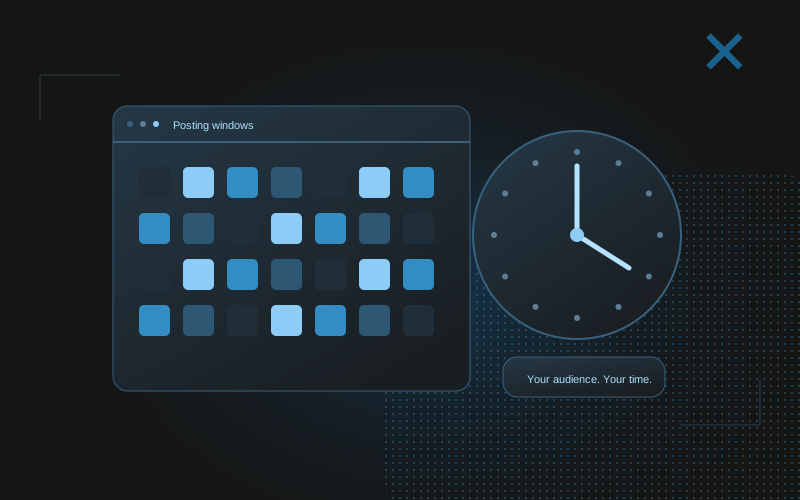
Use broad windows initially. Hour-by-hour rankings fragment a small history into tiny groups. A comparison of morning, afternoon, and evening can be more informative than twenty-four loosely supported averages. Define boundaries once, ensure each post belongs to one window, and apply them consistently. Narrow a window only after you have enough comparable examples to justify the detail.
| Example window | Lisbon local time | Question to test |
|---|---|---|
| Morning | 08:00–11:59 | Do practical explanations reach relevant readers here? |
| Afternoon | 12:00–17:59 | Does this window suit product progress updates? |
| Evening | 18:00–21:59 | Are demos worth testing in this window? |
Keep timing separate from content quality
Before ranking windows, review which posts populate them. If morning posts are casual thoughts and evening posts are polished videos, you have a mixed content-and-timing comparison. Label topic, format, and intent so you can compare a narrower subset, such as standalone text explanations or screenshot-based product updates.
You may discover that the clean subset is small. Do not fix that by silently mixing replies, launch threads, and ordinary standalone posts. Report the available groups and plan a modest prospective comparison. A limited honest result is more valuable than a precise-looking winner created from incompatible examples.
Watch for outside distribution. A repost from a large account, a community event, or a product launch can change exposure. Record those events when known. You can still include the post, but examine whether the window ranking depends entirely on that one event. This is a sensitivity check, not permission to remove every inconvenient result.
Compare mature results with a visible baseline
Pick a practical observation window for future posts, such as a metric snapshot at the same age after publication. The exact age is a workflow choice; consistency matters more than claiming a magic measurement period. When reviewing existing posts, distinguish those still accumulating exposure from older posts.
Calculate median reach for each eligible window and record its sample size. Also inspect the distribution: a group with similar results across several posts is different from a group whose average comes from one exceptional winner. Where available, add the response metric that matches your goal. Strong reach with no relevant response may not be the window you want to prioritize.
Here is an invented comparison: six morning updates have a median of 310 impressions, eight afternoon updates have 420, and two evening updates have 900. Afternoon is a plausible test candidate. Evening deserves more observations before you describe it as best. The numbers say what happened in these samples; they do not prove a schedule that will maximize future reach.
Run a timing test you can actually maintain
Prepare comparable posts about real work and alternate between the candidate windows over a manageable period. Avoid assigning all your strongest ideas to your preferred window. You cannot make different posts identical, but you can reduce obvious imbalances in topic, format, and effort.
Keep a simple log containing the candidate window, publication timestamp, post link, intended audience, and observation timestamp. If a launch or external mention changes distribution, add a note. Choose the primary comparison before looking at the results. Otherwise you can keep trying metrics until one supports the answer you wanted.
Leave room for the work itself. A window that requires you to interrupt customer calls or publish rushed material is not automatically worthwhile. Compare the practical cost of the routine with the strength of the evidence. The schedule should help you deliver useful posts, not become a reason to manufacture weak ones.
- Choose two realistic windows in one named time zone.
- Alternate comparable topics and formats across the windows.
- Collect metrics at a consistent post age.
- Review reach and the response that matters to your goal.
- Keep or revise the schedule based on the whole result.
Ask an agent for a comparison, not a magic hour
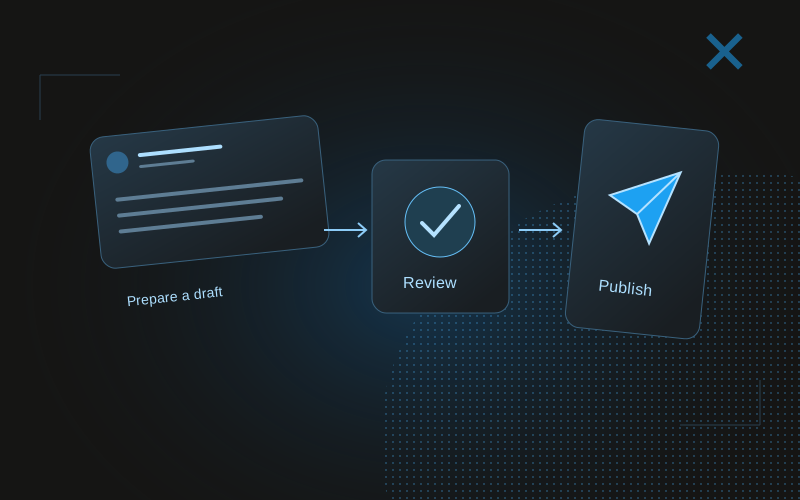
An agent can sort timestamps, group posts, and prepare the review. Give it the time zone, eligibility rules, and outcome metric. Ask it to show the observations behind its recommendation. Without these constraints, a fluent answer can hide that it compared a small set of incompatible posts.
If the agent reads a cached analytics source, require it to check collection freshness first. A recently generated report is not necessarily based on recently collected metrics. Distinguish the report creation time, collection time, and publication time. All three affect the meaning of “recent.”
X-tra’s read-only agent tools expose retained evidence and freshness information. They do not schedule or publish posts. Use an analysis assistant to identify candidate windows, then make the publishing decision through your normal workflow. That keeps your scheduling choice attached to evidence rather than to an invented universal optimum.
A prompt to adapt
Using the supplied post history, compare morning and afternoon in Europe/Lisbon. Include only comparable standalone progress updates. State collection freshness and post-age differences. Show median reach, group sizes, and the post IDs. Flag external distribution notes. Recommend a next timing test, and explain why the current evidence does not prove causation.Revisit timing when your context changes
A useful window can change when your audience, content, or routine changes. Keep your timing review attached to a coherent period, and revisit it after a meaningful shift rather than applying an old ranking forever. New audience regions or a move from text updates to demos are reasons to reconsider.
If the difference between windows is small or inconsistent, choose the schedule that supports better work and genuine conversation. Timing is one variable in a larger publishing practice. Clear ideas, credible examples, and relevant distribution still need attention even when your schedule is well organized.
Common questions
Is there one best time to post on X?
No account-specific conclusion follows from a universal timetable. Use general schedules as hypotheses, then compare your own audience, content, and results.
Should I analyse posting time in UTC or local time?
Either can work if you use it consistently and state it clearly. Named local time zones are useful for planning and handling seasonal clock changes.
Can X-tra automatically post at my best time?
The current X-tra agent integration is read-only. It can support analysis of retained history; it does not publish or schedule posts.