What to take into your next post
- Compare complete, consistently defined weeks and similar post ages.
- Separate account totals, typical post performance, and business outcomes.
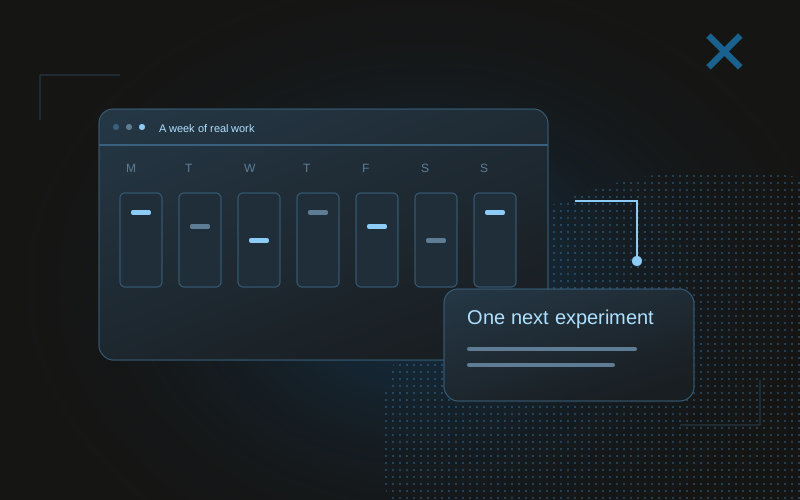
- Finish with one next experiment and a record of the decision.
Define the week before comparing it
Choose the account’s planning time zone and a consistent week boundary. Monday through Sunday is a useful default for many workflows, but the important property is consistency. State the exact dates and time zone in each report. “This week” should not silently mean the last seven days in one section and the current calendar week in another.
A week still in progress is not comparable with a complete previous week on totals alone. You can report the partial period, compare equivalent elapsed days, or wait for the full review. Make that choice explicit. Do not describe a Monday morning total as a collapse compared with seven completed days.
Also state the collection timestamp and retained coverage. A report prepared on Monday can still contain metrics collected before Sunday’s last posts had time to accumulate exposure. A calendar boundary gives structure to the review; it does not automatically make every observation equally mature.
Separate total activity from typical post performance
Begin with a small set of facts: how many retained posts belong to the period, what metrics are available, and what the account-level snapshots cover. Then distinguish totals from per-post performance. More posts can increase total exposure even if the typical post reaches fewer people.
Use median post reach as one view of the typical result, and keep total reach as a different view of activity. If response metrics are available, report the ones relevant to your goal. A website conversion belongs to your website measurement, not to an inferred number produced from likes or impressions.
Here is an invented example. Last week had five posts, a median of 400 impressions, and a total of 2,900. This week had ten posts, a median of 300, and a total of 4,200. Distribution grew in total while the typical post received less reach. Both statements can be true. The next decision depends on whether the additional effort produced the audience response you wanted.
| Illustrative metric | Previous week | Reviewed week |
|---|---|---|
| Retained posts | 5 | 10 |
| Median impressions | 400 | 300 |
| Total impressions | 2,900 | 4,200 |
| Interpretation | Fewer, typically stronger posts | More exposure, lower typical reach |
Review topics and intentions before selecting a winner
Group posts by defined topics and intentions. A topic might be onboarding or performance; an intent might be teaching, progress, or announcement. Keep format as a separate dimension. This lets you notice whether a subject is promising across formats or whether a format only worked with one particular subject.
Show group sizes with the result and inspect the underlying posts. A week may contain only one announcement or two videos. Those groups can supply examples, but they do not justify a broad ranking. Use several recent comparable weeks when the current week is too sparse, and disclose the longer period.
Avoid vague labels generated from repeated phrases. A phrase such as “big win” is not a meaningful content topic. Prefer labels a reader can understand and verify against the posts. If an agent proposes categories, review representative examples and merge categories that do not correspond to a useful distinction.
Read the strongest and weakest examples
Choose a few posts to inspect closely, including weaker examples in a promising group. Ask what was visible to the reader: a concrete result, a confusing opening, a useful explanation, a screenshot without context, or a claim the artifact did not support. The review should connect metrics with creative decisions without pretending to know the algorithm’s internal reasons.
Look for outside distribution and unusual context. A larger account’s repost, an event, a release, or a widely discussed topic may explain part of the exposure. Record known events and leave unknown causes unknown. “This post received more reach” is an observation; “the algorithm loved the hook” is speculation unless you have evidence that actually supports it.
Check meaningful responses. A useful question, a relevant enquiry, or an informed disagreement can be more actionable than an undifferentiated like count. Summarize what the responses reveal about understanding and interest. Keep private messages out of public reports unless you have appropriate permission to share them.
Give the agent a fixed report contract
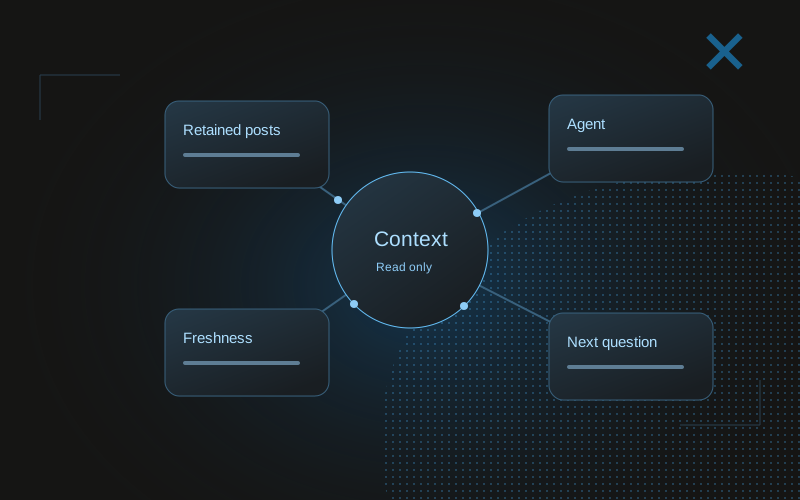
The assistant should know the period, time zone, comparison rules, data source, and output shape before it begins. Require it to check freshness and state limits. Then ask for account observations, post-group comparisons, specific examples, and one recommended experiment. A fixed shape makes consecutive reviews easier to compare.
Ask the agent to keep observations and explanations separate. When it recommends sharing more demos, it should name the posts and comparison that support the recommendation. When evidence is weak, it should say what additional data would help. Do not require a confident recommendation at any cost.
X-tra’s current agent tools can supply retained evidence and folder comparisons. They cannot refresh X on demand or publish the suggested experiment. An assistant using those tools should report the cache’s collection times and not call the output a live audit.
A prompt to adapt
Prepare a weekly X review for the stated Monday–Sunday dates in the account time zone. Check data freshness first. If either period is incomplete, explain that before comparing totals. Report retained post counts, median reach, relevant response metrics, and follower snapshot coverage. Compare defined topics and intents with sample sizes. Cite strong and weak post examples. Separate observations from speculative explanations. Finish with one experiment, its expected signal, and the next review date.Choose one experiment for the coming week
Use the review to select a decision you can act on. If concrete progress updates repeatedly look promising, plan a fresh series about real improvements. If a topic receives relevant questions but limited reach, consider making the explanation clearer rather than abandoning the subject. If the results are too sparse, the action may be to collect a more balanced sample.
Define the experiment before publishing. Name the audience, creative choice, baseline, and observation window. Add what would weaken the idea. This prevents the next review from becoming a retrospective attempt to declare success under a different metric.
Keep the workload proportionate. The review should improve your next posts, not consume the time needed to do the work those posts describe. A useful weekly outcome can be one clearer demo, one better explanation, or a decision to stop repeating a weak format. More volume is not the default solution to uncertainty.
Preserve the decision so the next review can learn
Save a short memo with the period, data freshness, key observation, limitations, and next experiment. Begin the following review by checking that experiment. Did you run it as planned? Were the posts comparable? Did an outside event change the context? What decision follows from the evidence now?
A decision log makes progress visible even when reach fluctuates. You may learn that a topic consistently brings relevant questions, that your strongest demos need a clearer opening, or that a posting window has no dependable advantage. These are useful outcomes that a collection of isolated performance screenshots would hide.
The role of X-tra is to help assemble and compare the posting evidence. The role of the agent is to organize a review you can inspect. Your role is to judge the creative direction and business goal. Keeping those responsibilities clear gives the weekly routine a purpose beyond producing another report.
Common questions
Should I compare the current week with last week?
Only after defining the periods and accounting for an incomplete current week. Use complete weeks or equivalent elapsed periods, and disclose post-age and collection differences.
What if I only posted a few times this week?
Use the week for descriptive observations and review a longer recent period for group comparisons. Keep the different periods explicit and avoid ranking tiny groups as settled patterns.
What is the main output of a weekly content review?
One practical next decision, supported by the relevant evidence and recorded so the next review can evaluate it. A long report without a next action is less useful.